NewWoodworker.com, woodworking how to, woodworking tool reviews
Browse our Archive of Frequently Asked Question
NWW Gear Store   -   NWW on YouTube   -   NWW GuildNewsLetter   -   Contact Us  -  About Us   -   FAQ's  -  Donate  -  Advertise

Home
Articles
Basics
Books
How-To DVD's
NWW Forums
Links
Parts & Pieces
Plans
Projects
Reference
Tips & Tricks
Tool Reviews
Video
Woodturning
Writing Services

Search Rockler.com's Extensive Woodworking Catalog

Search from over
15,000 products!

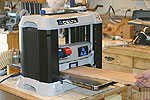
Delta #22-580, 13" Finish Planer

Accurate, useful features in an easy to use - and buy -package

Text & Photos by Tom Hintz

The wide-ranging capabilities and features of the Delta 22-580 planer make it a great compromise between ineffective low-buck versions and the far more expensive floor models.
Click image to enlarge

   Surface planers have evolved into one of the must-have tools of the modern woodworking shop. The ability to accurately size and finish lumber is important to building accurate projects. Add the capability to process rough-cut wood and produce the exact thickness needed for a specific job adds a huge amount of flexibility to your shop and allows you to take advantage of the lower prices of rough cut stock.

Initial Impressions

   The Delta #22-580 planer is physically larger than anticipated. At 20"-tall, 23"-wide, 15"-deep and weighing at 92 lbs, it is obvious that this is no lightweight toy. Much of that size is a result of the impressive array of features that come as standard fare along with a large capacity. As I would find during the evaluation of the Delta #22-580 planer, the features and capabilities add up to working faster, more accurately and producing a better finish on the wood.

Instructions, Assembly and Set Up

   The multi-lingual instruction manual is clearly written and supported by lots of photos and illustrations that explain setup and use procedures in detail. The Delta #22-580 planer comes almost fully assembled so the majority of the manual is devoted to explaining the use, care and maintenance of the features. Taking a little time to read and understand this information will make using the Delta #22-580 planer easier and more productive.

Motor

   The Delta #22-580 planer is powered by a 15 Amp motor that produces a cutterhead speed of 10,000 RPM. This may seem like more power than is needed but the motor also drives the feed roller system. To consistently

This is part of the drive mechanism for the cutterhead and part of the reason this machine is durable and accurate.
Click image to enlarge

cut and feed, a little extra power is a good thing and the Delta #22-580 planer shows no signs of lacking in that department.

   The cooling fan in the motor also provides an airflow that helps clear the impressive amount of chips a planer creates. A port on the rear of the motor housing directs a stream of air into the dust shroud to keep the debris moving outward. If you use the Delta #22-580 without an external dust collector attached you get so see this in action. Keep the broom handy.

Cutterhead

   The heart of any planer is the cutterhead, its efficiency and how easily the woodworker can maintain that performance. The Delta #22-580 planer features a heavy 2-blade cutting cylinder mounted in a head that is guided by wide bearing points on four corner posts. Combined with the headlock mechanism, this system

The knife changing/locating system on this machine is easy and very accurate with no fancy tools, skills or luck needed to get the knives properly aligned.
Click image to enlarge

does a very good job of keeping the cutter head assembly aligned, operating smoothly and virtually eliminating snipe in the process.

Simple Knife Changing

   The Delta #22-580 planer uses a pair of double-edged knives, each precisely located by 3 pins. This design reduces knife changing to loosening the spring-loaded clamp bar enough to slip the old knife out using the included magnetic carrier. The new knife (or the old one, turned around to use the second edge) is placed in the carrier, inserted in the cutterhead over the three locating pins and the clamp bar tightened. There is no further knife alignment needed, or possible.

   This automatic knife alignment system is an important feature for the average consumer as it insures the planer will return to the same level of performance when new knives are installed. With the older knife-mounting systems, complicated alignment procedures, made even more difficult by working in cramped quarters, often meant the planer would never work quite as well again. Those problems are gone with the Delta #22-580 planer.

An easy to use handle locks and unlocks the cutterhead.
Click image to enlarge

Cutterhead Lock

   Snipe, a slight dishing at the beginning and often the end of a board, has been the Achilles heel of thickness planers for years. The Delta #22-580 planer includes cutterhead lock technology that drastically reduces snipe. In our testing, snipe was eliminated if the material is adequately supported.

   Locking or unlocking the cutterhead is accomplished through an external handle on the side of the Delta #22-580 planer. Though not a high-tech system mechanically, this cutterhead lock is very effective.

2-Speed Cutting

A simple switch changes feed rate to best suit reducing or finishing wood.
Click image to enlarge

   Another handy feature on the Delta #22-580 planer is the 2-speed feed rate. The "dimensioning" setting of 60 CPI (cuts per inch) moves the material through the cutters at a slightly higher rate. The "finishing" setting of 90 CPI produces a finer finish on the wood by slowing the feed rate slightly.

   The dual feed rates can be useful on different types of woods also. Softer woods can often be surfaced at the faster setting with good results while hardwoods usually need the slower finishing setting to achieve the optimum surface quality.

Blade Zero Indicator

The Blade Zero indicator speeds initial height setting and makes that operation safer.
Click image to enlarge

   This is a handy feature that can improve safety. In the past, I would have to set the wood to be planed under the cutterhead and (with the machine off) lower the head until it contacted the wood. Then I'd have to crank in a guestimate of depth to make the first pass. Too deep and the planer strained. Too shallow and the piece could stop midway through or worse, get kicked out.

   The Blade Zero Indicator makes it easy to set the initial cutterhead height so a light full-contact cut can be taken on the first pass with the wood safely gripped by the rollers.

Height Adjustment

In addition to the 1/16" change per revolution, the height adjuster handle has an adjustable fine increment ring around its base.
Click image to enlarge

   Raising and lowering the cutterhead is controlled by turning a large crank handle on top of the Delta #22-580 planer. Each full turn of the crank changes the cutterhead height by 1/16". The crank handle also has a repositionable scale ring around its base with graduations representing 1/128" of adjustment. With the cutterhead at the base height, zero this ring to the pointer on the cabinet and you can make small but very accurate changes to the depth of cut.

Depth Stop

The Depth Lock is great when making several pieces the same thickness. And, it is very accurate!
Click image to enlarge

   The Delta #22-580 planer also has a full range depth stop that makes repetitive cutting accurate and much faster. To engage the depth stop simply lower the cutting head to the final thickness desired and then turn the depth stop down to where it meets the cutterhead. Depress the stop knob and give it a quarter turn and the depth setting is limited at that point. You can raise the cutterhead to begin working a new board but the downward travel will stop at this locking point.

   In our testing, the Depth Stop was used often and produced thicknesses among several boards within a few thousandths of an inch.

Tables Extensions

The large infeed-outfeed tables go a long way to preventing snipe. Ours came perfectly aligned but adjusting them is easy if need be.
Click image to enlarge

   The tables that extend the planers inner table are important to the quality of the finish and for controlling snipe. The Delta #22-580 planer has 12 5/8"-deep by 13"-wide tables on the infeed and outfeed sides that with the machines deck add up to a 35"-long by 13"-wide support surface.

   It is important to note that these tables are hinged and supported from the machine itself without contacting the surface around the planer. This eliminates irregularities in the table or benchtop that could miss-align the tables inducing snipe or other irregular cuts.

   The tables are adjustable to be sure they remain perfectly flat with the interior surface of the planer.

Dust Collection

If this is your first planer, get this dust port and connect it to your dust collector. Your shop, and broom, will thank me.
Click image to enlarge

   Probably the biggest "wow" factor awaiting the first-time surface planer owner is the volume of chips these machines are capable of spewing across the floor. Having experienced this in the past and swept up the resulting mess, I added a Delta #50-446, 4" dust connector to the Delta #22-580 planer before connecting it to my Delta 50-760 dust collector and turning it on for the first time.

   Aside from being efficient, a nice feature of the 50-446 dust connector is that it places the hose to the side of the machine and not hanging onto the outfeed table. In addition, this dust connector can be installed with the outlet aimed to the right or left without modification.

   Installing the 50-446 ($24.95 - 4-3-2005) connector is a simple, no-tools task that takes far less time than sweeping up a few seconds worth of planning debris.

In the Shop   

Using external support when working with long pieces helps prevent damaging the planer or causing torque-induced snipe.
Click image to enlarge

Before planning the first piece of wood, all of the setup procedures were performed on the Delta #22-580 planer as prescribed in the instruction manual and alignments checked. The tables were aligned perfectly with the planer floor right out of the box. The outfeed rollers measured 0.002" below the knife arc, also right on spec. The knives themselves were checked for alignment with the table even though there is no adjustment and found to be within 0.001" of parallel.

   To check the knife locating mechanics, both were removed, turned around and re-installed according to the instructions. Once again, the dial indicator confirmed that both knives were within 0.001" of parallel to the table.

   The first operating tests involved laying a piece of pine scrap on the table, engaging the Blade Zero mechanism and lowering the head until it clicked off. The wood was pulled back, the machine started and the wood sent through. The Delta #22-580 planer made a very light cut the full length of the board. A half turn of depth was added and the board sent through again. No snipe and a very smooth surface. Then I remembered that I had not engaged the Head Lock.

   All subsequent cuts were made with the Head Lock engaged. Regardless of the species being planed, with very rare exceptions there was no apparent snipe on either end of the boards. Occasionally I would notice a tiny amount of snipe on the leading edge of the boards only. The infrequency of this snipe makes me think it was caused by poor technique on my part rather than the machine. When I make sure it was flat on the table as it went under the rollers, I never found any snipe.

The top roller comes in handy when making multiple passes on longer lengths.
Click image to enlarge

   However, there is a way to induce snipe on any planer. Running a long board through without support outside of the planer tables allows the weight of the board to torque the leading and trailing ends up into the knives. I was able to cause snipe by sending a 6"-wide piece of oak nearly 7-feet-long through the Delta #22-580 planer, supported only by the built-in tables. The weight of the board hanging down on entry and exit, even though I tried to hold it level managed to increase the cut depth slightly and cause snipe approximately 3"-long at either end. That same board was planed with no snipe by adding work supports adjusted to be level with the infeed and outfeed tables to the front and rear of the Delta #22-580 planer.

   While external support for long pieces of material is a common sense point, it appears to be one that is forgotten often judging by the emails we receive. Too often, the snipe caused by this error in technique has been blamed on the planer when that is not the case.

   All of the features including the depth stop worked as advertised or better. The dual speed feature is not as important on soft woods as it is on harder varieties like oak or walnut. When the wood gets tougher, this is a very nice feature to have and one that produces an extremely smooth surface that will require very little sanding to get ready for finish.

   The Delta #22-580 planer has a foam-covered roller across its top that is meant to make moving a board from the outfeed, back to the infeed side easier. At first, I thought this was more of a marketing feature, until I used it while planning a longer board. It turns out that this is a very good and useful idea.

   After planning a large number of boards during testing and preparing two projects worth of oak, all of the setup measurements were repeated and found to have remained unchanged. The quality of the surface produced by the Delta #22-580 planer remained very smooth and square to the table surface.

Conclusions

   The Delta #22-580 planer Finish Planer is a good quality, accurate machine that appears to be a durable as it is accurate. With a little common sense care and maintenance, it will provide many years of service.

   For many woodworkers, the Delta #22-580 planer is an affordable compromise between low-buck, less capable "entry level" planers and the large but expensive floor models that can cost several times the street price of $369.99 (4-4-2005) of the Delta #22-580 planer.

   The 13" width, 6 ½ maximum and 1/8" minimum thickness capacity of the Delta #22-580 planer is more than sufficient for the vast majority of home woodworking projects.

   If you need a surface planer in your shop, consider the capacities, features and price of the Delta #22-580 planer as you shop.

Do you have a comment about this page? - Email Me!

Back to the Tool Reviews List


Note: The opinions expressed in NewWoodworker.com Tool Reviews are my own and have not been adjusted for nor approved by Internet forum experts. - Tom Hintz, Publisher, Newwoodworker.com LLC.
All NewWoodworker.com Custom Plan Sets, written, photographic and drawn materials are property of and copyright by NewWoodworker.com LLC 2001-2010 . Materials may not be used in any way without written permission of the owner.

Privacy Statement