About Us
Contact Us
FAQ's

Home
Articles
Basics
Books
Links
Plans
Projects
Reference
Tips & Tricks
Tool Reviews
Tool Room
Video
Woodturning

Search Rockler.com's Extensive Woodworking Catalog

Search from over
9000 products!

Search Woodcraft.com for All Your Woodworking Needs


Search Woodcraft.com For ALL Your Woodworking Needs!

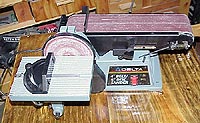
The Delta Sanding Center is another tool that is even more useful than I anticipated.
Click image to enlarge

Delta # 31-460 Sanding Center

4"-wide belt- 6"-diameter disk

Text & photos by Tom Hintz

Update: The Delta Sanding Center has been replaced because after roughly 7 years of hard use, it finally gave up. In its life it was a surprisingly good sander that more than met my expectations of a benchtop machine.

   I had been using a drum sander attachment in my drill press for nearly all of my fine edge sanding chores, many with less than perfect results. On inside curves, the drum sander is hard to beat. On straight lines, the drum is passable with practice. When it comes to outside curves, in my hands anyway, a drum sander produces results you might expect from a hand grenade. To avoid attempting outside curves with the drum sander I was doing all sorts of odd things, none of which produced good results.

   Whenever I visit a store with woodworking tools, I make a pass through those isles, regardless of why I was actually there. Recently, with a particularly frustrating outside edge drum sander experience fresh in my mind I noticed the Delta Sanding Center and knew instinctively it was the answer to several of my sanding woes. Minutes later I was backing up to the garage with another Delta box in the trunk.

The adjustments are up front, logical and work well.
Click image to enlarge.

   This machine comes needing very little assembly, and good instructions for what does need putting together. The most complex adjustments during setup are setting the pointers on the tilt table and miter gauge. A combination square and two minutes had the sander ready to go.

   The Delta Sanding Center comes with a 60 grit disk and belt though many other grits are available. ( FYI - I noticed that my local Lowe's carries the adhesive-backed disks in a range of grits as a standard shelf item.) At first I thought 60-grit might be a bit rough but found both the disk and belt produce surprisingly nice surfaces, ready for the ROS if you do not lean on the work piece excessively.

   Some of the features I like include the tilting work table, the variable angle belt and an effective dust port.

Work Table

   The work table on the Delta Sanding Center has a 45-degree tilt range with an easy-to-read indicator. Once the pointer was set, the table indexed accurately throughout its range. A nice feature of the table is the distance from the sanding surface can be adjusted, and the table can be moved from the disk to the belt easily. The miter gauge for the table is plastic but has a 60-degree range that again, stays surprisingly accurate. It also has a pair of v-blocks molded in that can be used for truing or beveling the ends of dowels or small stock.

The table support is surprisingly solid, and is easily moved to be used with the belt. (Arrow)
Click image to enlarge

   The 8 7/8 X 6 1/8-inch work table is suspended in front of the sanding surface from below, and that caused me a little concern about it's stability. During assembly, I noticed the support is both large and made from cast metal. The result is a table that is surprisingly solid. Adding a larger work surface may not be a good idea, but with adequate support, surprisingly large pieces can be accurately sanded on the table.

Sanding Disk

   After assembly, I dug out a scrap of red oak, drew an arc on a corner. My first surprise is how fast this disk removes material. Only light pressure is needed to take the piece down to the line. I found that once you get the hang of pivoting the work piece, you can literally split a pencil line, producing an almost finished outside curve the needs only finish sanding.

   Another useful technique is learning where on the disk to apply the work piece. Because it is a disk, the center turns much slower than the outside edges. When you need more control to ease up to a line, move to the center of the disk. If a larger amount of material is to be removed, go towards the outside of the disk and things happen much faster.

   The work table extends across the entire face of the disk, but it is important to remember that the right half is coming up, the left side going down. I have successfully sanded a larger piece using the full face of the disk but light pressure on the disk and a firm grip on the workpiece is necessary. When the work will stay on the left side, control is easy, and very solid.

Sanding Belt

   The belt portion of the Delta Sanding Center can be set anywhere from horizontal to vertical, a full 90-degrees of movement. A single Allen screw is loosened (with the supplied wrench) to make angle adjustment, and then tightened.

   So far, most of my uses for the belt have been in the horizontal position. There is a "fence" near the left end of the belt that allows the work piece to be "floated" over the sanding surface.

   The belt features a tracking adjustment that actually works, and a quick-release for the belt tension for changing belts. Both adjustments are easily accessible on the front of the belt arm. The only catch is when changing belts; the work piece stop has to be removed. The good news is removing two bolts, both easily accessible, is all it takes.

   The useable flat sanding surface is 4 X 12-inches in dimension. Because it is open on the right side, longer pieces can be sanded. I have found the belt surface to be just the ticket when trying to flatten small angles. I recently had to make a pair of leg supports for a cabinet, but their size made cutting in the table or miter saw dangerous. I cut them on the band saw, and then sanded them down to my layout lines in seconds.

   When the belt is raised towards vertical, the work table can be moved to support your work. A single Allen screw is loosened, the table with it's mounting shaft removed and plugged into a similar socket at the belt end of the unit. The combination of belt and table adjustability should make sanding virtually any angle a snap.

Dust Port

   A 2 ¼-inch ID dust port is located at the left end of the unit. Simply lugging in your dust hose provides very good dust collection. Dust collection is a little less efficient at the disk than the belt, but the amount of dust left is small and presents no problem.
   

Pricing Link

This Delta Sanding Center may not have the horsepower or work surface capacity of the larger units but I find it to be a very effective addition to my shop. The speed with which I can accomplish sanding tasks on this machine almost make me wonder about its worth. I do not seem to use it much. However, when I consider what I would have to go through to do the same job without it, the Delta Sanding Center is worth every penny.

Conclusions

For the home woodshop that lacks the budget and space for a larger sander, the Delta Sanding Center is a good choice. It is very effective for its size and with a little thought, can handle larger jobs than it appears capable of.

Visit the Delta Tools web site!

Do you have a comment about this page? - Email Me!

Back to the Tool Reviews List


All NewWoodworker.com Custom Plan Sets, written, photographic and drawn materials are property of and copyright by NewWoodworker.com LLC 2001-2009 . Materials may not be used in any way without written permission of the owner.
Privacy Statement